Boyne Valley Laser Studio9 min read14 sections
xTool O1 Omni Printer: Editions, Workflows and Business Fit
The xTool O1 ships in three factory configurations, not three price tiers. Here's what each edition prints, which workflows it unlocks, and where it fits in a small personalisation business.
On this page14 sections
- 1.What is the xTool O1 Omni Printer?
- 2.The three O1 editions at a glance
- 3.The four workflows explained
- 4.Single UV Edition — the straightforward choice
- 5.Dual-Head UV Edition — the UV production workhorse
- 6.UV + DT Fabric Edition — one machine, two markets
- 7.Pixel-Scan and jigs
- 8.Rotary and roll-fed workflows
- 9.Materials, ink and maintenance
- 10.How the O1 works alongside an xTool laser
- 11.Which edition fits which business?
- 12.Is the O1 suitable for a small business?
- 13.Frequently asked questions
- 14.Next steps
Short answer: buy the Single UV if you print flat and cylindrical items one at a time, the Dual-Head UV if print time is already your bottleneck, and the UV + DT Fabric only if garments and textiles are a real part of your order book. The editions are separate factory builds, not upgrade tiers.
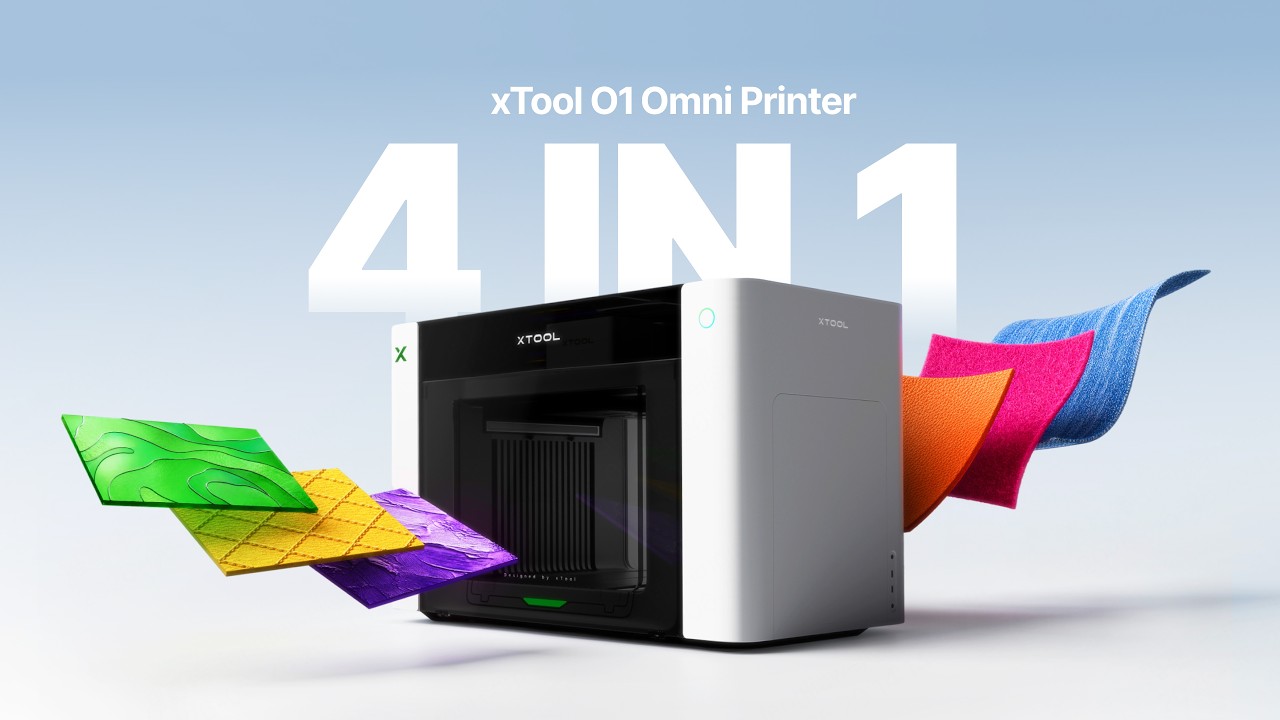
The xTool O1 Omni Printer brings full-colour UV printing into an xTool ecosystem that, until now, has been built around laser cutting, engraving and marking. For personalisation studios, sign makers, promotional-product suppliers and existing xTool owners, it opens up product categories that a laser simply cannot produce.
The catch: the O1 ships in three factory configurations — Single UV, Dual-Head UV, and UV + DT Fabric. They are not entry-level, mid-range and premium versions of the same machine. Each one is built around a different production model, and xTool does not describe them as field-upgradeable between configurations.
This guide explains what each edition actually does, which workflows and accessories you need, and where the O1 fits — or doesn't — inside a small or established personalisation business.
What is the xTool O1 Omni Printer?
The O1 is a desktop direct-to-object printer that uses UV-curable ink. Instead of removing material like a laser, it deposits ink onto the surface of an object and cures it with ultraviolet light.
Depending on the configuration and accessories chosen, the platform can support four distinct production methods:
- Direct UV printing — full colour, white and varnish printed directly onto the object.
- UV DTF transfers — prints applied via film to hard surfaces.
- Direct-to-garment (DTG) — textile ink printed straight onto cotton and natural-fibre garments.
- Fabric DTF transfers — multi-stage film transfers for a wider range of fabrics.
Not every edition supports all four. Which ones you get is decided at the point of purchase.
The three O1 editions at a glance
- Single UV
- 1 × Epson F1080
- Dual-Head UV
- 2 × Epson F1080
- UV + DT Fabric
- 2 × Epson F1080
- Single UV
- Yes
- Dual-Head UV
- Yes
- UV + DT Fabric
- Yes
- Single UV
- Yes
- Dual-Head UV
- Yes
- UV + DT Fabric
- Yes
- Single UV
- No
- Dual-Head UV
- No
- UV + DT Fabric
- Yes
- Single UV
- No
- Dual-Head UV
- No
- UV + DT Fabric
- Yes
- Single UV
- No
- Dual-Head UV
- Yes
- UV + DT Fabric
- No
- Single UV
- No
- Dual-Head UV
- Yes
- UV + DT Fabric
- No
- Single UV
- Rigid products
- Dual-Head UV
- Advanced UV printing
- UV + DT Fabric
- UV printing + apparel
- Single UV
- 720 × 1,440 dpi
- Dual-Head UV
- 720 × 1,440 dpi
- UV + DT Fabric
- 720 × 1,440 dpi
- Single UV
- ±0.2 mm
- Dual-Head UV
- ±0.2 mm
- UV + DT Fabric
- ±0.2 mm
- Single UV
- 7 mm
- Dual-Head UV
- 7 mm
- UV + DT Fabric
- 7 mm
| Feature | Single UV | Dual-Head UV | UV + DT Fabric |
|---|---|---|---|
| Printheads | 1 × Epson F1080 | 2 × Epson F1080 | 2 × Epson F1080 |
| Direct UV printing | Yes | Yes | Yes |
| UV DTF (with laminator) | Yes | Yes | Yes |
| DTG printing | No | No | Yes |
| Fabric DTF printing | No | No | Yes |
| Flexible-white UV ink | No | Yes | No |
| Fluorescent UV colours | No | Yes | No |
| Main commercial focus | Rigid products | Advanced UV printing | UV printing + apparel |
| Max resolution | 720 × 1,440 dpi | 720 × 1,440 dpi | 720 × 1,440 dpi |
| Positioning accuracy | ±0.2 mm | ±0.2 mm | ±0.2 mm |
| Max raised texture | 7 mm | 7 mm | 7 mm |
The main UV printing area is 330 × 420 mm with the large print bed. The UV + DT Fabric edition also includes a separate 300 × 390 mm direct-to-garment platen.
The four workflows explained
Direct UV printing
Ink is deposited directly onto the object. White ink can sit underneath the colour image to keep opacity on transparent, coloured or dark materials, and varnish can add gloss, spot highlights or a raised tactile finish up to 7 mm.
Typical applications:
- Acrylic signs, wooden plaques, metal panels and awards.
- Glass, ceramic and phone cases.
- Promotional products, branded packaging and personalised gifts.
- Display pieces and product prototypes.
This is fundamentally different from laser engraving. A laser changes the material itself. The O1 adds colour and texture on top. For most businesses the two processes are complementary rather than interchangeable.
UV DTF transfers
UV DTF prints the design onto specialist transfer film first. The finished transfer is then applied to the final product. Useful when the object is too large, awkwardly shaped, or when transfers need to be produced in batches for later application — including by a customer or trade buyer.
All three O1 editions can produce UV DTF transfers, but the xTool laminator is required to complete the workflow. UV DTF is for hard surfaces — do not confuse it with fabric DTF, which is for textiles.
Direct-to-garment (DTG)
DTG applies textile ink directly to a garment or fabric item. Available only on the UV + DT Fabric edition, and generally best suited to compatible cotton and natural-fibre garments with the correct pretreatment and curing process.
Fabric DTF
Fabric DTF prints onto film, applies adhesive powder, cures the transfer, and heat-presses it onto the garment. It supports a wider range of fabrics than DTG — including certain synthetic and blended materials — but remains a multi-stage process. The O1 does not remove the need for the appropriate film, powder, curing method and heat press.
Single UV Edition — the straightforward choice
The Single UV Edition is the most direct configuration. It supports full-colour UV printing using CMYK, white and varnish through a single printhead that manages the required passes.
It is a strong fit for businesses focused on rigid products: acrylic signage, wooden and metal items, awards, phone cases, packaging, glass, ceramic and personalised gifts. The main limitations are the absence of flexible-white ink, fluorescent UV colours, and any textile workflow.
Dual-Head UV Edition — the UV production workhorse
The Dual-Head UV Edition keeps the focus on UV printing but adds two production-relevant capabilities: flexible-white ink for stretch and conformable materials (leather, canvas, certain plastics) and fluorescent UV colours for branded items designed for UV-lit environments.
The parallel dual-head system can also materially reduce production time on multilayer prints — colour plus white plus varnish plus texture — versus a single-head machine doing the same passes sequentially. Actual print time still depends on mode, dimensions, resolution, layer count, white coverage, varnish and finish.
If UV-printed hard goods are the product line and apparel is not on the roadmap, this is the most commercially capable configuration.
UV + DT Fabric Edition — one machine, two markets
The UV + DT Fabric Edition combines direct UV printing with textile printing. It supports direct UV, UV DTF, DTG and fabric DTF — four workflows from one machine — but its second printhead is dedicated to textile printing. That means it does not include the Dual-Head UV edition's flexible-white or fluorescent UV inks.
Pick this edition when apparel is a real product category alongside UV-printed hard goods. Skip it if UV printing is the whole business and premium multilayer finishes matter more than garments.
Pixel-Scan and jigs
The O1's Pixel-Scan vision system scans the bed and shows the operator where a product is sitting, so artwork can be placed over a visual representation of the object before printing. That helps with:
- One-off personalisation and mixed batches.
- Irregularly shaped products and phone cases.
- Objects with openings or existing features that artwork must align to.
- Products that vary slightly in size between units.
Production jigs still earn their place when the same product runs repeatedly, alignment must be identical across many pieces, or throughput matters. Treat Pixel-Scan and jigs as complementary — vision for flexibility, jigs for repeatability.
Rotary and roll-fed workflows
A separate rotary attachment handles cylindrical items — tumblers, bottles, cups — by turning the object under the printheads. The optional roll-to-roll feeder supports continuous UV DTF film runs of roughly 15 metres and other compatible roll materials of around 12 metres. Useful for repeated decals, gang sheets, product labels, trade supply and batch promotional work.
Whether the roll accessory earns its keep depends on real order volume. If most orders are individual sheets or single objects, it can wait.
Materials, ink and maintenance
xTool lists a wide range of UV-printable substrates: acrylic, wood, metal, glass, ceramic, leather, plastic, coated products and selected flexible media. In practice, colour, adhesion and durability vary substantially between substrates — expect to keep a materials test file for the surfaces you use most.
UV printing needs more active ink management than a home printer. White ink pigment settles when stationary, and the O1 counters that with automated stirring, ink circulation, temperature and humidity management, printhead moisture protection, cleaning cycles, sleep/wake routines, a Vacation Mode, and remote monitoring through the xTool app.
How the O1 works alongside an xTool laser
The O1 is not a replacement for a laser cutter or engraver. It cannot cut acrylic or wood, mark stainless steel, cut leather, laser-engrave glass, produce deep relief or remove coatings. Its role is to add colour, white, varnish and texture on top of what a laser produces.
A combined workflow typically looks like:
- Cut the product shape on a laser.
- Print the colour artwork on the O1.
- Add engraved details or coating removal where useful.
- Apply UV DTF graphics to secondary surfaces.
- Assemble the finished piece.
Which edition fits which business?
Choose the Single UV Edition when…
- Most of the work is rigid products.
- Flexible-white ink and fluorescent effects are not required.
- Apparel is outside the planned product range.
- Entry cost is a decisive factor and volumes are modest.
Choose the Dual-Head UV Edition when…
- UV printing will be a core, ongoing production service.
- Leather, canvas or flexible products are important.
- Fluorescent effects have commercial value for the brand.
- Multilayer print efficiency matters and apparel does not.
Choose the UV + DT Fabric Edition when…
- Garments are a real product category, not an occasional job.
- The business needs one machine covering both hard goods and apparel.
- You are prepared for the pretreatment, curing and heat-press workflow that DTG and fabric DTF require.
Is the O1 suitable for a small business?
Potentially, yes. Its commercial value lies in the number of short-run and personalised products a single machine can produce without investing in several unrelated printing systems — full-colour gifts, acrylic signs, branded products, awards, packaging, drinkware, UV DTF transfers, phone cases, leather goods, and (on the UV + DT edition) apparel.
The right questions are not just "can it print this?" They are: is the product profitable, how long does it take, what preparation is required, how much ink does it consume, and how durable is the finished print? Those answers only appear once you have run real jobs on your real substrates.
Frequently asked questions
Can every xTool O1 print clothing?
No. Only the UV + DT Fabric Edition supports DTG and fabric DTF printing.
Can every O1 produce UV DTF transfers?
Yes, according to xTool's current product information. The xTool laminator is required to complete the UV DTF workflow.
Can the Single UV Edition be upgraded to Dual UV later?
No. The editions are factory-configured and are not described by xTool as field-upgradeable between configurations. Choose the edition that fits the product range you plan to sell.
Does the UV + DT Edition include flexible-white UV ink?
No. Its second printhead is assigned to textile printing. Flexible-white and fluorescent UV inks are features of the Dual-Head UV Edition.
Next steps
If the O1 looks like a fit, the most valuable next step is comparing complete operating packages — machine, laminator, roll feeder, rotary, ink sets and consumables — not the advertised machine-only entry price.
Ready to look at pricing and packages? Check current xTool O1 Omni Printer options and bundles — or get in touch with the studio for a workflow consultation.
Keep going
xTool machine
xTool F2 Ultra UV
Cold-process UV marking for plastics, glass, leather, and heat-sensitive substrates that would scorch or warp under fibre or CO₂..
Read more about xTool F2 Ultra UVService
xTool consultation
Objective pre-purchase advice from a studio that runs the machines daily.
Read more about xTool consultationJournal
xTool F2 Ultra UV vs F2 Ultra Dual: which one for your work?
Both are flagship galvos, but they're built for almost opposite jobs. Here's how to decide which xTool F2 Ultra you actually need.
Read more about xTool F2 Ultra UV vs F2 Ultra Dual: which one for your work?Get the next xTool guide in your inbox
xTool tips, new services, live event dates and project inspiration — once a month, no spam.