
Boyne Valley Laser Studio9 min read11 sections
xTool X1: Can One Machine Really Replace Multiple Laser Engravers?
The upcoming xTool X1 promises to bring CO₂ cutting, high-speed galvo engraving and multiple laser technologies together in one expandable machine. But what does that actually mean for makers and businesses in Ireland?
On this page11 sections
- 1.What is the xTool X1?
- 2.Why are different laser types necessary?
- 3.Hybrid Motion: Combining galvo speed with a larger working area
- 4.Laser Swap: The X1's most significant feature?
- 5.Could the xTool X1 replace the P3, F2 Ultra or F2 Ultra UV?
- 6.Is the xTool X1 worth waiting for?
- 7.xTool X1 price and release date in Ireland
- 8.Buying an xTool X1 in Ireland: Our perspective
- 9.Frequently asked questions about the xTool X1
- 10.Find out more about the xTool X1
- 11.Official information and further reading
Anyone who has worked with laser engraving for a while will know that one laser cannot necessarily do everything.
A machine that works brilliantly on wood and acrylic might struggle with bare metal. A fibre laser capable of engraving stainless steel may be completely unsuitable for cutting clear acrylic. And UV lasers introduce another set of possibilities, particularly for glass and certain plastics.
Until now, expanding into different materials has generally meant investing in additional machines.
The xTool X1 is designed to challenge that approach.
The X1 is an upcoming all-in-one laser platform combining different processing technologies within a single system. Rather than simply placing several laser heads in one enclosure, xTool has developed a modular architecture intended to make different laser sources work through a coordinated processing system.
At Boyne Valley Laser Studio, we regularly work with CO₂, diode, MOPA fibre and UV laser systems. Each has strengths, limitations and applications where it makes more sense than the alternatives.
That experience makes the X1 particularly interesting to us. However, there are also some important questions to consider before deciding whether it could replace several dedicated machines.
This is a pre-release technical overview based on information published by xTool. We have not independently production-tested the X1.
xTool X1 official preview
Playing this video connects to YouTube.
What is the xTool X1?
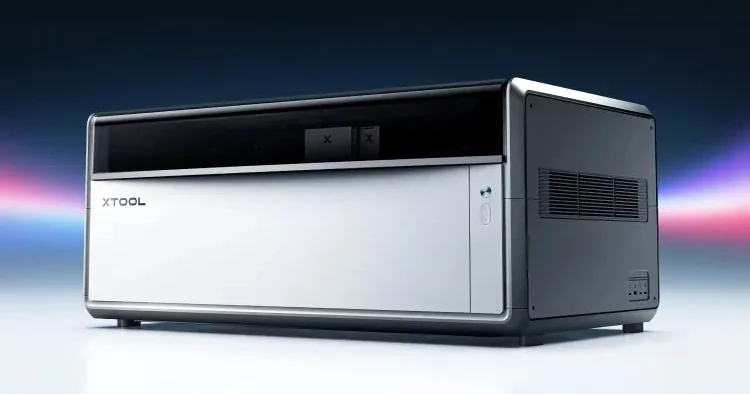
The xTool X1 is a modular laser engraving and cutting platform designed to combine the versatility of different laser sources with the working area of a gantry machine and the speed of a galvo system.
Its announced capabilities include:
- A 55W CO₂ laser for cutting and engraving suitable materials.
- A 20W blue diode laser integrated into a compatible galvo processing head.
- Optional 30W fibre, 60W MOPA and 5W UV laser modules.
- Hybrid Motion technology combining mechanical movement with high-speed galvo scanning.
- Laser Swap technology allowing compatible laser sources to share the galvo processing architecture.
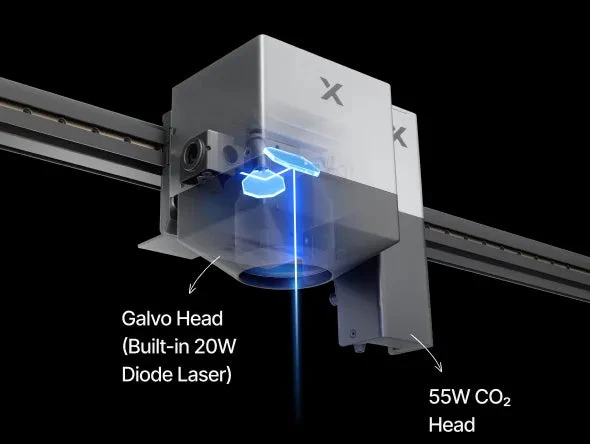
An important distinction is that the CO₂ laser uses a separate processing head. It does not travel through the shared galvo optical system.
The exact standard configuration, optional bundles and final Irish pricing have yet to be confirmed. Buyers should not assume that every advertised laser source is included with the base machine.
Why are different laser types necessary?
The answer comes down to laser wavelength, the properties of the material being processed and the result you're trying to achieve.
Different materials absorb laser energy differently. A laser that performs exceptionally well on one material may produce a poor result, or no useful result at all, on another.
Here is how the X1's announced laser technologies compare.
- Typical applications
- Cutting and engraving wood, suitable acrylic, leather and other non-metal materials
- Typical applications
- High-speed marking and engraving of suitable woods, coatings and selected materials
- Typical applications
- Metal marking, identification plates, serial numbers and industrial-style engraving
- Typical applications
- Advanced metal marking, deep engraving and additional control over certain metal finishes
- Typical applications
- Fine marking on suitable glass, plastics and heat-sensitive substrates
| Laser source | Typical applications |
|---|---|
| 55W CO₂ | Cutting and engraving wood, suitable acrylic, leather and other non-metal materials |
| 20W blue diode | High-speed marking and engraving of suitable woods, coatings and selected materials |
| 30W fibre (optional) | Metal marking, identification plates, serial numbers and industrial-style engraving |
| 60W MOPA (optional) | Advanced metal marking, deep engraving and additional control over certain metal finishes |
| 5W UV (optional) | Fine marking on suitable glass, plastics and heat-sensitive substrates |
These are general applications of the laser technologies, not a guarantee that every material or process has been validated on the X1.
An important technical distinction is that MOPA is itself a type of fibre laser. Its advantage is greater control over pulse characteristics, which can provide additional flexibility in metal marking and engraving.
Likewise, a UV laser's lower heat input can make it useful for certain sensitive materials, but it does not automatically make every plastic suitable or safe for laser processing.
This is why choosing a laser should always start with the material and the required finish rather than simply comparing wattage.
Hybrid Motion: Combining galvo speed with a larger working area
One of the most interesting developments in the X1 is xTool's Hybrid Motion technology.
Traditional gantry lasers move a processing head mechanically across the work area. This is well suited to cutting larger shapes, but the repeated movement and acceleration of the head can limit engraving speed.
Galvo lasers use rapidly moving mirrors to steer the laser beam. They are exceptionally effective for detailed engraving, fine text and repetitive marking, but their scanning fields are generally more limited.
The X1 aims to combine these advantages through a coordinated four-axis system.
The mechanical gantry positions the galvo processing head across the work area, while the galvo mirrors handle rapid local engraving.
The potential advantage is faster, detailed engraving across larger workpieces without repeatedly repositioning the material.
However, scanning speed is not the same as real-world production throughput.
Actual job time will depend on the material, artwork, required engraving depth, laser source and processing settings.
And importantly, the high-speed galvo system does not mean the CO₂ laser cuts materials at galvo engraving speeds.
The real value will become clearer when independent production testing demonstrates how the system performs across different jobs and materials.
Laser Swap: The X1's most significant feature?
For many businesses, the X1's expandable laser architecture could be even more valuable than its speed.
With traditional equipment, adding a new laser technology usually means buying another complete machine.
That involves another enclosure, motion system, workspace, extraction arrangement and potentially another set of accessories.
xTool's Laser Swap system takes a different approach.
The X1's 55W CO₂ laser operates through its own processing head. Separately, the galvo processing system incorporates a 20W diode laser and supports compatible external laser sources through a shared optical architecture.
The optional fibre, MOPA and UV modules connect at the rear of the machine rather than requiring a completely separate engraver.
In practical terms, a business could potentially start with a configuration suited to its immediate requirements and expand into more specialised marking applications as demand develops.
It is important to understand that this is not five lasers operating simultaneously.
Different laser sources are selected for the relevant processing stages, and overall production capacity remains limited by the shared machine.
Nevertheless, the potential to expand capabilities without repeatedly purchasing separate complete laser systems is a significant development.
Could the xTool X1 replace the P3, F2 Ultra or F2 Ultra UV?
This is one of the questions we're most interested in answering.
At Boyne Valley Laser Studio, our equipment includes the xTool P3 CO₂ laser, F2 Ultra Dual MOPA and diode laser, and F2 Ultra UV.
Using different machines in real production gives us a useful perspective on why dedicated laser systems still have their place.
For example, our 80W xTool P3 is designed around larger-format CO₂ processing. The X1's announced CO₂ source is 55W, so there is no reason to assume it would outperform the P3 in heavier cutting applications.
Similarly, dedicated galvo machines such as the F2 Ultra Dual provide compact, high-speed marking capabilities without occupying the space of a larger cutting machine.
The F2 Ultra UV is especially relevant where UV marking is a primary workflow rather than an occasional requirement.
The X1's advantage is potentially different: bringing a broad range of capabilities into a single expandable platform.
That could make it particularly attractive for a small workshop producing personalised gifts, signage, jewellery, awards and a changing range of customer products.
However, a business with consistent, high-volume work may still be better served by dedicated equipment.
Two separate machines can process two different jobs at the same time. One multi-laser machine cannot automatically replace that parallel production capacity.
And for a business that needs only one laser technology, paying for flexibility it will never use may not make commercial sense.
Is the xTool X1 worth waiting for?
That depends on what you intend to make.
If you're planning to establish a laser engraving business in Ireland and expect to work with a wide variety of materials, the X1 is certainly worth investigating.
The combination of CO₂ cutting, galvo engraving and modular laser sources could reduce some of the compromises traditionally associated with choosing a first machine.
It could also be interesting for established businesses looking to expand their services without filling the workshop with additional equipment.
However, we would be cautious about delaying an immediate business requirement solely because a new machine has been announced.
A proven machine that meets your current workload can be a better investment than waiting for capabilities you may not need.
Before making a purchasing decision, we would want to establish the X1's actual working area, cutting performance, marking quality, module changeover workflow, total price and reliability under sustained use.
We would also want to assess how its shared processing system performs when switching between different materials and laser sources.
These practical factors matter far more than a headline specification.
xTool X1 price and release date in Ireland
The xTool X1 has been announced as an upcoming product, with technical information being released ahead of its commercial launch.
As of 11 October 2026, confirmed Irish retail pricing, final bundle configurations and delivery dates have not been publicly established.
Buyers should also remember that the complete cost will depend on which optional laser modules they require, along with suitable extraction, accessories and any installation or training requirements.
We will update this article as xTool publishes further information.
Buying an xTool X1 in Ireland: Our perspective
Choosing the right laser is about more than the number of materials listed on a manufacturer's website.
A successful setup needs to deliver the right finish, at the required production speed, with a workflow that is commercially sustainable.
At Boyne Valley Laser Studio in Dunshaughlin, Co. Meath, we work with multiple laser technologies and provide practical advice, machine demonstrations, commissioning, operator training and materials testing.
As Ireland's first xTool Pro Hub, we can also assist customers considering an xTool purchase and discuss partner pricing where available.
Although we cannot currently offer a production-tested X1 demonstration, we can demonstrate existing CO₂, diode, MOPA and UV systems and help you understand the differences before deciding whether the X1 is worth waiting for.
If you're considering investing in an xTool X1, or deciding between the X1 and an existing xTool model, contact Boyne Valley Laser Studio to discuss your requirements.
You can also read our practical guide to buying a laser cutter in Ireland or learn more about buying an xTool through our Irish Pro Hub.
Frequently asked questions about the xTool X1
Can the xTool X1 engrave metal?
The X1 is designed to support metal marking through its optional 30W fibre and 60W MOPA modules. The appropriate source and settings will depend on the metal and desired finish. These modules should not be assumed to be included with the standard machine.
Can the xTool X1 cut clear acrylic?
The announced 55W CO₂ laser should make the X1 suitable for processing appropriate clear acrylic. However, maximum thickness, cut quality and processing speeds need to be assessed against final manufacturer specifications and practical testing.
Does the xTool X1 have a UV laser?
The X1 supports an optional 5W UV laser module through its Laser Swap architecture. It is not the same as saying that UV capability is included in every X1 configuration.
Is the xTool X1 better than the xTool P3?
They are designed around different priorities. The P3 offers an 80W CO₂ system focused on larger-format cutting and engraving, while the X1 prioritises combining multiple laser capabilities. Which is better depends on the workload, budget and required materials.
Can the xTool X1 replace multiple laser machines?
Potentially, for businesses that need different laser capabilities but do not require simultaneous operation.
The X1's modular architecture could reduce the need for separate machines. However, production throughput, working area, module pricing and the specific materials being processed will determine whether it is a practical replacement.
Where can I get advice about the xTool X1 in Ireland?
Boyne Valley Laser Studio is an official xTool Pro Hub based in County Meath. We provide advice on choosing xTool equipment, demonstrations of our existing laser systems, commissioning, training and materials testing.
Find out more about the xTool X1
If you're considering the X1 for your business, we'd be happy to discuss your intended materials, products and workload.
We can also help you compare it with the existing xTool range and discuss available purchasing options when launch details are confirmed.
Official information and further reading
Published: 11 October 2026. This article covers a pre-release product and will be updated as further technical and commercial details become available.
Disclosure: Boyne Valley Laser Studio is an xTool affiliate and Pro Hub partner. We may earn commission on qualifying purchases, at no additional cost to the buyer.
Keep reading
Laser Cutters in Ireland: A Practical Buyer's Guide
What Irish buyers actually need to know before ordering a laser cutter: the machine types, the costs beyond the sticker price, and why seeing one running locally beats a spec sheet.
Read postThe True Cost of Owning an xTool in Ireland
The machine is only the first invoice. Here is the honest first-year cost picture for Irish xTool owners — and where buying through a Pro Hub changes the maths.
Read postGet the next xTool guide in your inbox
xTool tips, new services, live event dates and project inspiration — once a month, no spam.